

Using AI and linguistics to map positive climate narratives in UK and Canadian media
Why do positive climate narratives and hopeful news stories matter?
Much climate coverage focuses on threat and loss. Stories about solutions, action and hope can help people see opportunities for action. ClimateHopeAI studies how hopeful climate narratives appear in UK and Canadian online news, and how AI can help identify them without losing the human, linguistic and social side of climate communication. It supports NCIT’s aim to tell stories that move people.
How does ClimateHopeAI use data science to find climate solutions in media?
ClimateHopeAI combines three areas of expertise: data science and AI, social computing and persuasive design, and narrative and linguistic analysis. To understand how hopeful climate stories spread, the project analyses news articles and identifies recurring themes, patterns and narratives. The team built a cross-national corpus of climate news and analysed it with sentiment classification, republication detection, network analysis and topic modelling. They developed categories for constructive climate stories, including community and corporate initiatives, ecological restoration, political agreements and technology-based solutions.
- ClimateHopeAI is a partnership between the University of Exeter (UK), the University of British Columbia Okanagan (Canada) and the Federal University of Rio Grande do Sul (Brazil).
- The ClimateHopeAI team is Dr Marcos A. de Oliveira Jr, Dr Ifeoma Adaji, Dr Aseel Ali and Estefania Tamayo-Pineda.
- The team presented the poster “Prompting for Meaning: Evaluating LLM-Based Linguistic Annotation of Positive Climate Narratives in Online Media” at Environmental Intelligence 2026 in Exeter, 7–9 September 2026.
- ClimateHopeAI held workshops on interdisciplinary collaboration in Kelowna, Canada, in March 2026 and in Exeter in July 2026.
- ClimateHopeAI is supported by an Exeter–UBCO Initiator grant, which funded a one-week research visit to UBC Okanagan in Kelowna in March 2026.
- An interactive dashboard sharing the findings is in its final stage of development.
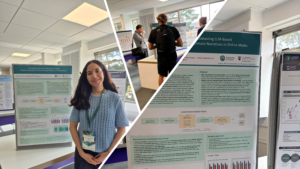
Estefania Tamayo-Pineda presents the ClimateHopeAI poster at Environmental Intelligence 2026 in Exeter, September 2026.
Next steps
- Finish testing AI-assisted annotation against examples coded by researchers.
- Validate the findings with stakeholders, following UBCO ethics approval.
- Launch the interactive dashboard.
- Submit the full paper, “ClimateHopeAI: Towards an AI-Driven Framework for Identifying Positive Climate Narratives in Online Media”, to a peer-reviewed computer-science venue.
- Build a long-term research group across the UK, Canada and Brazil, and seek external funding.

The ClimateHopeAI team, Dr Ifeoma Adaji, Estefania Tamayo-Pineda and Dr Marcos A. de Oliveira Jr, at UBC Okanagan, Canada, in March 2026.
Opportunities for collaboration
We’re looking for climate communicators, journalists and newsrooms to help test and validate our findings, and for funders to support the next phase of the work across the UK, Canada and Brazil.
Contact: Dr Aseel Ali (A.Ali6@exeter.ac.uk) and Dr Marcos A. de Oliveira Jr (m.oliveira-jr@exeter.ac.uk).
Related links:
- NCIT Communications: See how NCIT turns climate and nature science into hopeful, accessible stories.
- GCRP Media Hub: Explore science resources for journalists and newsrooms.