
An AI climate referee that fact-checks climate claims and images
How can you tell if a climate claim or photo is real?
Climate misinformation spreads quickly online, and AI-generated images and videos are making it harder to tell what is real. ClimaVAR works like the Video Assistant Referee (VAR) in football: it reviews a contested climate claim and gives a clear, science-based verdict. Using the familiar language of football helps it reach people who may not usually engage with climate information. It reflects NCIT’s aims to tell stories that move people and to build tools that others can use.
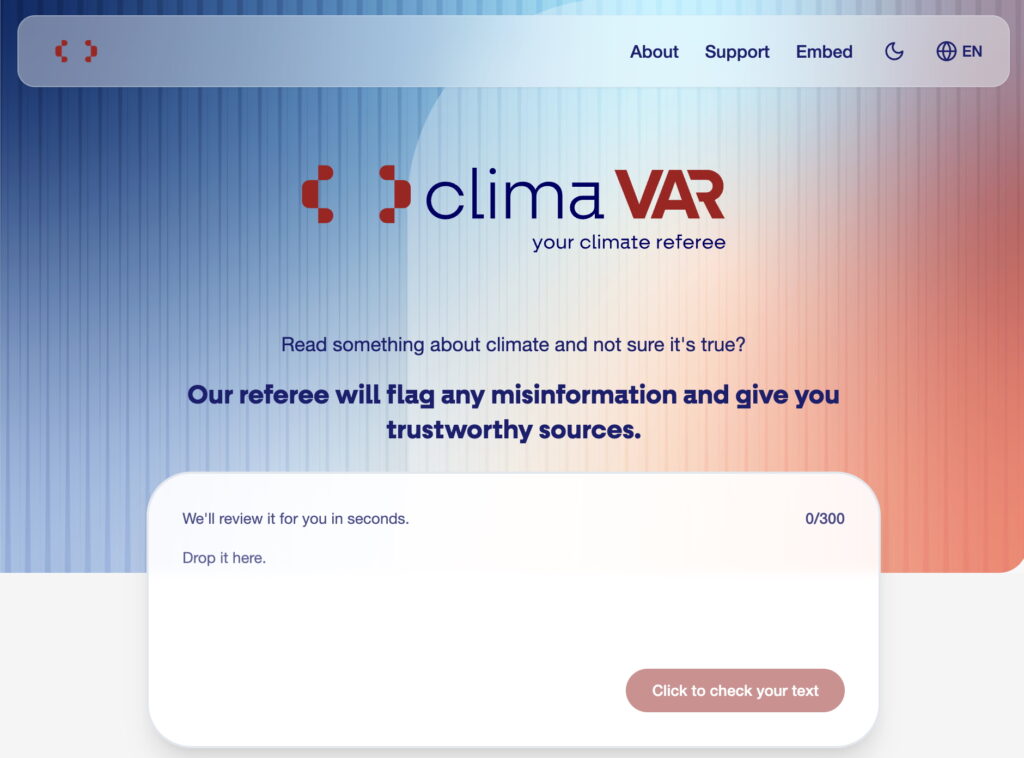
ClimaVAR’s text check: paste in a climate claim and the referee reviews it against trusted sources.
How does ClimaVAR check climate claims and what are the results?
ClimaVAR checks a climate claim or image and gives its verdict as a referee’s card: red, yellow or green. The text check compares claims with published science using ClimateGPT, a 2026 Webby Award winner from the ClimateGPT Foundation, and explains the verdict in football language. The media check assesses whether an image looks AI-generated, and checks for video or audio clips are under development. When ClimaVAR cannot be sure, it declines to give a verdict rather than guess.
- ClimaVAR is developed by the Nature & Climate Impact Team at the University of Exeter, led by Dr Aseel Ali and Dr Marcos A. de Oliveira Jr. It is open source and free to use at climavar.com.
- ClimaVAR was presented at COP30 in Belém, Brazil, on 13 November 2025, in the session “ClimaVAR: Fighting Climate Misinformation with AI & Football”. This led to an invitation to speak about climate disinformation and AI at TEDxCountdown in Erechim, Brazil, on 28 March 2026.
- ClimaVAR launched at the World Economic Forum Annual Meeting in Davos in January 2026.
- As of October 2026, ClimaVAR has active users in 56 countries, with the highest use in the United States.
- Of the ClimaVAR checks that reached a verdict, 16% were given a red card for misinformation and 25% a yellow card because they needed more context.
- ClimaVAR gives verdicts in five languages: English, Portuguese, Spanish, Arabic and Turkish.
- ClimaVAR’s media check began checking images in September 2026 and returns a result in under two seconds on average; checks for video and audio are under development.
- Before release, the ClimaVAR image check was tested on images known to be real with different features, and none was wrongly flagged.
- The paper “Red Cards for Climate Myths: introducing ClimaVAR, an AI-based Tool for Climate Disinformation Detection” was named one of the eight best papers at SEMISH 2026 in Gramado, Brazil, in July 2026.
- ClimaVAR featured in two campaigns around the 2026 FIFA World Cup in June and July 2026: Forced Break by Project Basecamp, with partners including NCIT, Where Football Lives, the Potsdam Institute for Climate Impact Research and ETH Zurich; and De Olho no Climão in Brazil.
- A 2026 World Cup campaign by NCIT’s Communications team, featuring ClimaVAR, reached 5.9 million views and paid impressions.
- ClimaVAR’s development was supported by ESRC translational
- In October 2026, ClimaVAR was awarded funding from the University of Exeter’s E&PR Fund to co-create a youth-friendly version with young people in Brazil, in partnership with Onda Solidária.
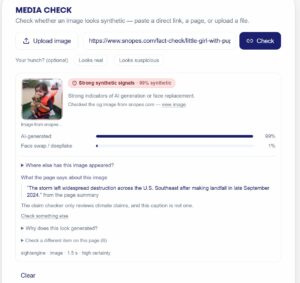
A ClimaVAR media check result: an image flagged with strong signs of AI generation.
What are the most common climate myths fact-checked by ClimaVAR?
What people bring to the referee: of the claims that received a verdict between December 2025 and October 2026, the most common topics were the causes of climate change (27%), energy and renewables (19%) and temperature and heat (16%). The claims most often given a red card deny that the planet is warming, blame warming on the sun or volcanoes, or say renewable energy is harmful, such as “wind turbines use more energy than they produce”. Most claims were checked in English (83%) and Portuguese (11%).
What are the limitations of AI image checking?
What ClimaVAR’s image check can’t tell you: a real photo with a false caption passes every check, and finding no sign of AI is not proof that an image is real. Screenshots and re-compressed files are harder to judge, and images with transparent backgrounds are refused. ClimaVAR shows these limits to users directly under the media check, in a note headed “What this can and can’t tell you”.
What is next for the ClimaVAR project?
In 2026–27, we plan to launch video and audio checks, add more languages and bring ClimaVAR to more football fans and fact-checkers. An expanded version of the SEMISH paper, adding the media check, is being prepared for a journal. In 2027, we will co-create a youth-friendly version of ClimaVAR with young people in Brazil, in partnership with Onda Solidária, with launches planned in Portuguese and English.
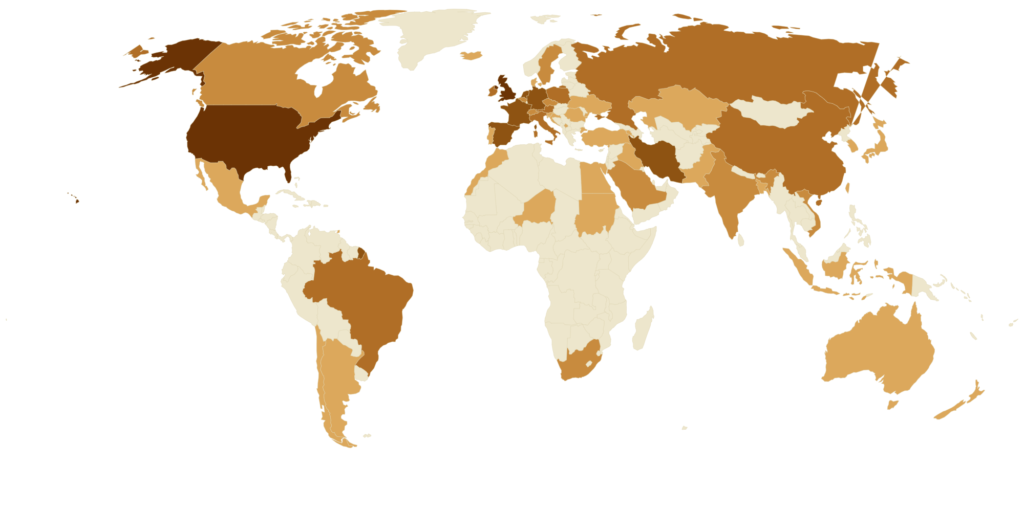
Where ClimaVAR is used: active users by country, as of October 2026. Darker shading means more users.
Get involved with ClimaVAR
We’re looking for fact-checking organisations, partners who can bring ClimaVAR to football audiences, such as clubs, fan groups, sports media, schools and youth organisations, and funders to support new languages and wider reach. Try ClimaVAR.
Get in Touch: Dr Aseel Ali (A.Ali6@exeter.ac.uk) and Dr Marcos A. de Oliveira Jr (m.oliveira-jr@exeter.ac.uk).
Related links
- NCIT events: Read about ClimaVAR at COP30 and its launch at Davos 2026.
- NCIT in the media: See coverage of ClimaVAR at COP30.