
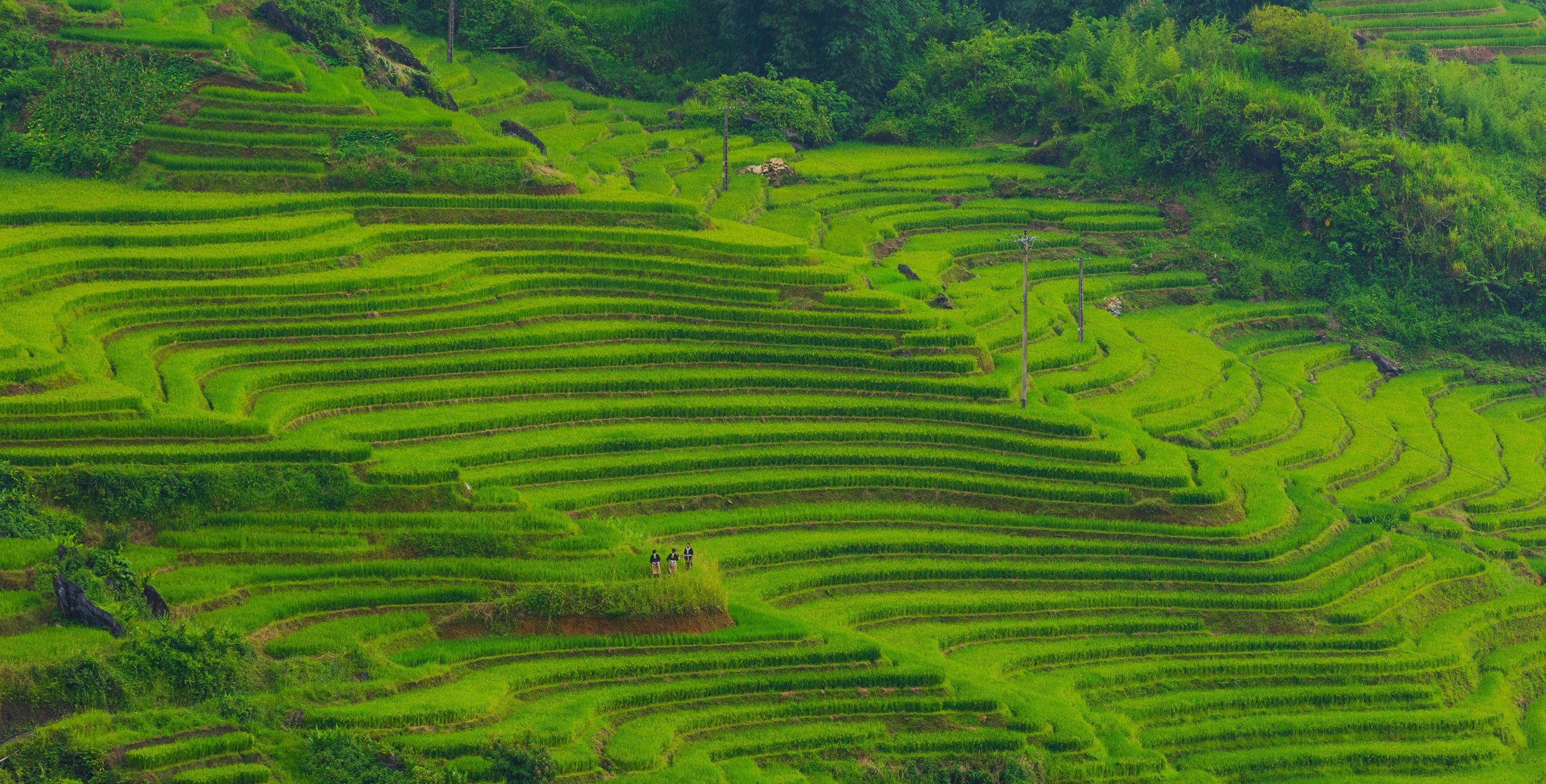

OpenAg is a groundbreaking initiative that exists to democratize agricultural intelligence, ensuring that farmers everywhere have free and equitable access to world-class knowledge developed with universities and agricultural experts, not controlled by corporations.
The Vision
OpenAg envisions a world where open-source agricultural innovations and collaborative knowledge-sharing empower every community to sustainably grow, access, and enjoy nutritious food, enabling a flourishing global food ecosystem for generations to come.
Core Mission:
OpenAg is building an AI-driven agricultural intelligence ecosystem that connects farmers, researchers, and policymakers through a real-time digital twin platform, knowledge graphs, and domain-specific AI models, turning raw data into actionable intelligence.
Key Innovations
- Foundational Models (SALMs): Unlike generic AI, OpenAg’s Small Agricultural Language Models (SALMs) are built from real-world, curated farming data to solve specific agricultural challenges.
- Offline-Capable AI: Farmers in remote areas can record data, receive insights, and sync automatically once online. No continuous internet connection required.
- Agentic Decision-Making: AI systems that analyze soil, weather, crop health, and farming conditions to deliver customized, predictive recommendations.
Consortium Partners
Institute of Applied Artificial Intelligence and Robotics (IAAIR): Provides AI research and development expertise, ensuring models are scientifically rigorous, continuously learning, and optimized for complex agricultural environments. https://iaair.ai/
Hamara Foundation: Connects OpenAg to 150,000 small-scale farmers across sub-Saharan Africa, providing real-world insights and validating AI-driven recommendations. https://hamara.co.zw/
The World Food Bank: Expands OpenAg’s reach to international agricultural markets, policymakers, and food production ecosystems for global scale. https://worldfoodbank.org/
Universities and Research Institutions: Contribute AI research, agricultural science, long-term experimental data, and co-develop AI-powered decision support tools.
Why Open-Sourced Agricultural Intelligence is Important
Agriculture today is at a crossroads. Knowledge is fragmented, expertise is locked away, and smallholder farmers lack access to real-time, AI-powered insights. Open-sourced agricultural intelligence addresses these systemic challenges and unlocks transformative potential for farmers, developers, and funders alike.
The Problem: Current Agricultural AI Limitations
Traditional agricultural AI systems face critical constraints:
- Black Box Systems: Little to no auditability, transparency, trust, or accountability.
- Cloud Dependent: Require continuous connectivity, impractical for rural areas with intermittent or no internet.
- Data Heavy: Rely on cloud-based services that are costly and inaccessible to smallholders.
- Too General: Skewed toward larger farm use cases, not tailored to smallholder realities
- Farmers as Recipients: Farmers are conceived as passive users rather than active contributors of knowledge
- Hallucinations: Generic AI produces unreliable or incorrect recommendations
- Proprietary Lock-In: Critical agricultural intelligence is trapped in closed, profit-driven systems.
What OpenAg Is Unlocking
For Farmers:
- Access: Free to download and use, fully offline-capable on-device (no data costs beyond initial download)
- Trust: OpenAg is “explainable”—it foregrounds traceable reasoning (e.g., “Because of X soil, Y variety, Z rainfall forecast…”) and encourages farmer contributions of their own technical and tacit knowledge
- Context-Aware Recommendations: Locally relevant, scientifically grounded advice on irrigation, pest management, soil conditions, and yield optimization.
- Equitable Access: World-class knowledge developed with universities and experts, not controlled by corporations.
For Developers and Researchers:
- Open-Sourced Proof of Concept: ECDPM, CGIAR, and World Bank cite the notable lack of open, peer-reviewable models. penAg fills this gap, aiding trust and governance.
- Federated Crop/Region-Specific Models: International partners (universities, governments, NGOs) can develop specialized SALMs connected by a shared framework and infrastructure.
- Reusable SALM Pipeline: Others can use this template to dramatically shorten development time for new crop-specific models.
- Benchmarking and Extension Integration: OpenAg allows benchmarking against known correct answers, testing for accuracy, relevance, completeness, safety, and hallucination behavior, providing a yardstick for continuous improvement.
For Funders and Policymakers:
- Public-Good Alternative: Bypasses profit capture and ring-fencing of for-profit businesses associated with proprietary, black-box models
- Investment in Smallholders: Small family farms occupy an estimated 70% of agricultural land and produce roughly 70% of the world’s food, yet receive a fraction of agricultural investment. OpenAg provides a no-regrets avenue for more investment in smallholders.
- Leverage Model: A template for universities and NGOs to approach donors: a small cash request that mobilizes substantial in-kind contributions within the OpenAg consortium.
- Scalable Impact: Through World Food Bank partner networks and integration within platforms like Hamara, SALMs can be disseminated to tens of thousands of farmers across multiple regions.
What Is the Rice Pathogen SALM?
Rice has been selected as the reference implementation for the SALM architecture due to:
- Global Significance: Rice is a staple crop sustaining over half the global population.
- Climate Sensitivity: Rice production is highly vulnerable to climate variability, water stress, and extreme weather
- Region-Specific Management: Rice requires complex, localized practices for irrigation, pest management, and soil conditions that vary dramatically across ecologies (upland, rainfed lowland, irrigated)
- Complex Pest and Disease Pressure: Rice faces significant pathogen threats (e.g., rice blast fungus, brown planthopper, rice yellow mottle virus) requiring nuanced, context-aware diagnosis and treatment recommendations.
- Smallholder Dependence: Millions of small-scale farmers across sub-Saharan Africa and Asia depend on rice for food security and livelihoods
Developing a Rice SALM provides immediate agricultural value while establishing a replicable framework for additional crops, creating a pathway toward thousands of domain-specific SALMs that collectively form the OpenAg ecosystem.
Technical Approach: “Small + Useful” Specialization
The Rice SALM project adopts a pragmatic specialization strategy rather than building a language model from scratch:
- Base Model Selection: A compact model in the 3–7 billion parameter range is selected for suitability for edge deployment following quantization.
- Domain Dataset Development: Rice-specific agronomic literature, irrigation protocols, soil management manuals, pest lifecycle documentation, and structured agricultural reports are curated, with expert-level reasoning scenarios generated and validated by agronomy specialists.
- Knowledge Graph Structuring: A rice knowledge graph covering soil types, nutrient interactions, pest taxonomies, and growth-stage transitions is built to ground the model’s reasoning in structured scientific knowledge.
- Fine-Tuning and Optimization: Parameter-efficient fine-tuning methods (e.g., LoRA) are applied to specialize the model for rice agronomy.
- Quantization and Edge Deployment: The model is compressed to low-precision formats (e.g., 4-bit) to enable execution on smartphones and low-resource devices.
- Validation and Benchmarking: The model undergoes staged validation combining quantitative benchmarking with structured expert review by agronomists to confirm scientific grounding and alignment with real-world management practices.
Meet The Rice SALM Project Team
The Rice SALM project brings together an interdisciplinary team combining AI engineering, knowledge integration, and agronomic validation expertise from the University of Exeter, IAAIR, and the Nature & Climate Impact Team.
Dr. Aseel Ali – Research Impact Fellow on Digital Technology at the Nature & Climate Impact Team, contributing expertise in digital technology and AI applications for climate and nature impact.
Dr. Richard Lindsay – Rice Agronomy Expert at the University of Exeter, responsible for defining agronomic requirements, validating Q&A scenarios, and reviewing model recommendations for scientific grounding.
Dr. Ivana Gudelj – Supervision & Support, University of Exeter, provides supervision and support for the Rice SALM project, contributing expertise in mathematical biology and complex systems.
Dr. Jia Hu – Machine Learning Expert, University of Exeter, leads machine learning aspects of the project, including fine-tuning, iterative optimization, and internal evaluation of the Rice SALM.
Dr. Hang Dong – Knowledge Graph Expert, University of Exeter, leads knowledge graph design and structuring for the Rice SALM, building the rice ontology and grounding/RAG integration that ensures the model’s reasoning is scientifically accurate.
Faezeh Safari – Project Team Member, University of Exeter, contributing to Knowledge Graph Development.
Fei Wu – Project Team Member, University of Exeter, PhD student contributing machine learning expertise.
Institute of Applied Artificial Intelligence and Robotics (IAAIR), lead technical partner and founding organization of OpenAg, providing AI research and development expertise, GPU compute infrastructure, reusable training/deployment pipelines, and senior technical oversight for the project.
Josh Ayers – Research Impact Fellow on Food Systems at the Nature and Climate Impact Team, controbuting project coordination and management.
Strategic Impact and Next Steps
Through established distribution pathways, including World Food Bank partner networks and integration within the Hamara Platform application ecosystem, the Rice Pathogen SALM can be disseminated to tens of thousands of rice farmers across multiple regions, enabling scalable delivery of scientifically grounded insights on irrigation scheduling, pest risk management, soil conditions, and yield optimization directly to farmers’ hands.
This project represents the foundation of a new paradigm for localized, federated agricultural AI, where every farmer, regardless of location or connectivity, has access to world-class, explainable, context-aware agricultural intelligence.